Search this site
- Enjoy Darwin
- 1942 Bombings
The Bombing of Darwin in 1942
The bombing of Darwin by the Japanese in World War 11 began in February 1942 with aircraft from four Japanese aircraft carriers, Akagi, Kaga, Hiryu and Soryu.
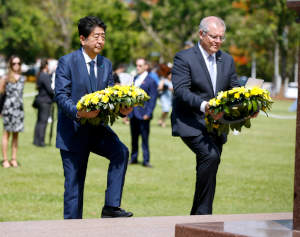 Japanese and Australian Prime Ministers lay wreaths in remembrance 2018
A National Day of Observance, known as the "Bombing of Darwin Day" is held each year on 19 February to remember those who fell during the attack.
Japanese Prime Minister Shinzo Abe was the first Japanese Prime Minister to visit Darwin in 2018, here seen laying a wreath in remembrance along with Australian Prime Minister Scott Morrison.
The day has also been remembered during a visit by US President Obama and by families of Japanese service men who died here during the conflict..
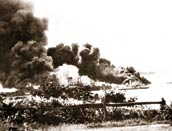
The first raid by 188 aircraft caused massive damage to the town and the sinking of 8 of the 45 ships in the harbour at the time.
Later the same day 54 land based bombers destroyed 20 military aircraft and inflicted further damage on the town.
While only 4 Japanese planes were shot down, 251 people were killed and around 350- 400 were wounded.
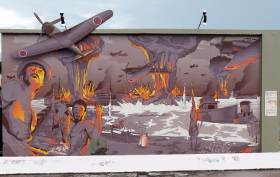 70th Anniversary Mural at Stokes Hill Wharf Remembering the Bombing of Darwin
Although this was the heaviest attack, Japanese planes continued to attack the north of Australia until November 1943 with more raids on Darwin, Katherine, Adelaide River, Batchelor Airfield, Broome, Townsville and other smaller bases and towns.
The few planes available to defend Darwin were still on the ground and were destroyed easily.
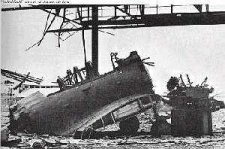 Bombing damage at Parap Airfield
Warnings from an Australian Coastwatcher on Melville Island and a Catholic Priest on Bathurst Island were thought to be mistaken sightings of a flight of US P-40E Kittyhawk fighters and ignored.
In much the same way a radar sighting was ignored at Hawaii when the Japanese bombed Pearl Harbour.
Damage from the original bombing is still visible at the hangar in Parap located behind Ross Smith Ave, which was the original Darwin Civil Airport. Now used as a museum and workshop by the Motor Vehicle Enthusiasts Club, the hangar is also an important part of the history of QANTAS Australia.
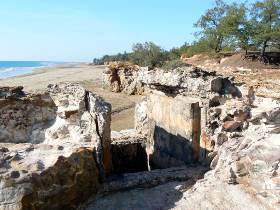 Wartime defence bunkers can be found along Nightcliff and Casuarina Beaches.
This crumbling gun emplacement at Casuarina Beach is one of the many traces of wartime activities still to be found around Darwin.
Other wartime sites include;
Bunkers in Charles Darwin National Park
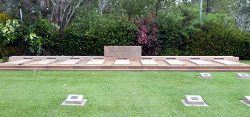 Post Office Workers Memorial at Adelaide River
A memorial at Adelaide River Civil Cemetery to nine of the Post Office Staff killed in the bombing is located next to the Commonwealth War Graves Cemetery
Street names in the suburb of Alawa and Moil also remember those killed during the war.
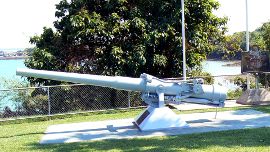 USS Peary Memorial on the Esplanade
The destroyer USS Peary was one of the ships sunk on the first bombing raid.
92 servicemen died aboard the ship during the raid.
Today a salvaged gun from the ship stands as a silent memorial, pointing towards the position where she was found after the war.
More on this Darwin bombing memorial here.
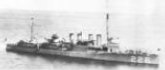
The USS Peary was a flush deck, ‘four stacked’ Clemson class destroyer, commissioned in 1920.
The remains of her wreck lie in about 27 metres in Darwin Harbour The wreck is a protected historic shipwreck under the Heritage Conservation Act.
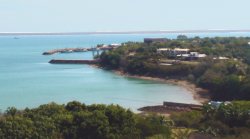 Doctors Gully was a wartime Catalina Base
Doctors Gully was a base for the long range Catalina Flying Boats.
With a range of 4000 km they provided an essential link during the war.
Looking across Doctors Gully towards the present day Naval Base is a much more peaceful scene today.
Darwin remains the base for surveillance of Australia's northern coastline.
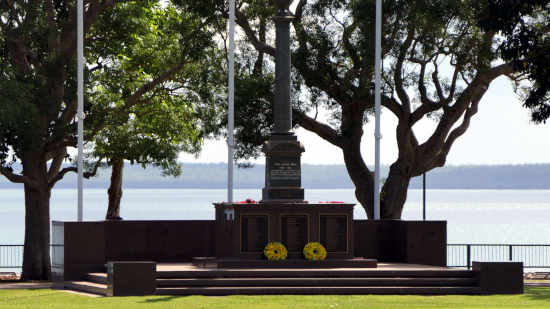 Wreaths laid by Japanese and Australian Prime Ministers at the Cenotaph overlooking Darwin Harbour.
Return from Bombing of Darwin to Enjoy Darwin.
Recent Articles


-
In Vogue Dancing
 with Linda and Murray (Darwin NT) InVogue Dancing Come and enjoy our weekly mix of Standard Ballroom and Latin American dances - mainly Sequence, some
 -
Flea markets operating around Darwin to buy,sell or swap your stuff
 Flea markets are always a popular place to visit and great places to unload all that stuff you don't need anymore.
 -
Acacia Dental Clinic
 Acacia Dentistry Care is committed to providing all dental care services all over the world. We all know that dentist care is expensive, but the services
 -
In Vogue Dancing
With Linda and Murray (Darwin NT ) InVogue Dancing Come and enjoy our weekly mix of Standard Ballroom and Latin American dances - mainly Sequence, some






日本語のダーーウィン情報を探しののははここららのサイををごごご覧
「ようこそダダーウ」
Darwin Community
Add your own Information or Comment on Articles in these Community Pages.
Community
- Art & Craft
- Clubs & Groups
- Community Forum
- Fishing
- Fishing Clubs
- Musicians
- Social Dancing
- Sports & Recreation
- Survival Guide
- Venues for Hire
Buy/Sell
History

 Community Banks® return profits to the community.